Roland Schmehl, TU Delft “Our focus is on scaling AWE systems and optimising their performance in wind farms.”
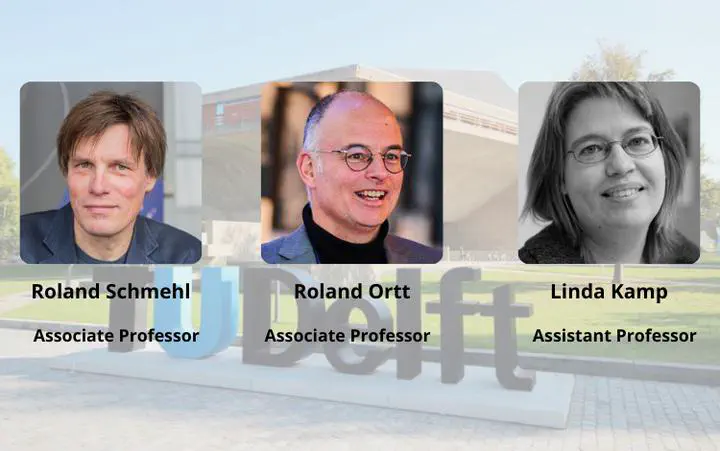
This week in our AWETRAIN supervisor interview series, we feature Roland Schmehl, Roland Ortt, and Linda Kamp from TU Delft – Delft University of Technology, a global leader in airborne wind energy research and the cradle of spin-offs such as Kitepower and Mozaero.
TU Delft has been at the forefront of AWE for over two decades, pioneering research on the design, operation, and commercialization of flexible kite systems. The university brings extensive expertise to AWETRAIN, covering computational fluid dynamics, aero-structural behavior of flexible kites, system scaling, regulatory and commercialization aspects, and societal impacts.
Roland Schmehl, involved in AWE research since 2009, explains, “our focus is on scaling airborne wind energy systems and optimising their performance in wind farms.” His team also develops open-source computational tools for simulating AWE systems and collects flight test data from industry partners, providing the foundation for validating models and guiding real-world deployments.
AWETRAIN tackles technical, regulatory, and social acceptance challenges in a system-level way. As Schmehl notes, commercial developers face questions such as, “to achieve a certain total energy output of a wind farm, will it be better to deploy more smaller airborne wind energy systems, or fewer larger systems?”
Roland Ortt adds, “the system that needs to be in place for large-scale use of AWE is comprised of actors and factors that pertain to different disciplines,” highlighting the importance of integrating technology with policy and market frameworks.
Linda Kamp, co-supervising a doctoral candidate with Ortt, emphasises AWETRAIN’s interdisciplinary and transdisciplinary approach: “AWETRAIN is interdisciplinary, but also even transdisciplinary, integrating scientific knowledge with industry experience.”
Doctoral candidates gain access to Kitepower, secondments at Kitemill, and TU Delft’s Graduate School programs, enabling them to “truly acquire transdisciplinary knowledge and skills and a transdisciplinary mindset,” which are essential for advancing airborne wind energy.
For the supervisors, mentoring the next generation is especially rewarding. Roland Schmehl reflects, “from 2015 until 2018, I coordinated AWETRAIN’s predecessor project, AWESCO, in which we trained the first generation of airborne wind energy doctors, providing an important boost to the technology’s development. There is still so much that we need to learn!”
Through AWETRAIN, TU Delft is preparing the next generation of airborne wind energy researchers to be interdisciplinary and ready to drive the large-scale adoption of this emerging renewable technology.

Jesús Carballo
Communications Manager
Driving communications and outreach in AWETRAIN, and supporting policy, regulatory development, and international collaboration efforts in Airborne Wind Energy.