Michael McWilliam, DTU “AWE has the potential to radically change the renewable energy landscape”
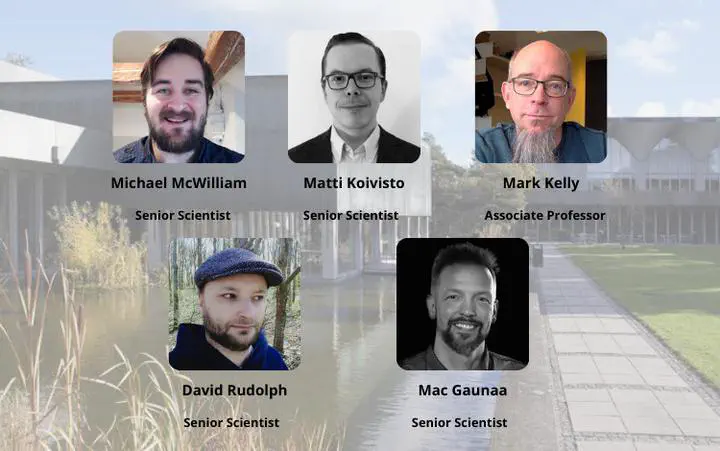
This week in our AWETRAIN supervisor interview series, we spoke with Michael McWilliam, Matti Koivisto, Mark Kelly, David Philipp Rudolph, and Mac Gaunaa from DTU – Technical University of Denmark’s Department of Wind and Energy Systems, one of the world’s leading wind energy research institutions.
DTU brings decades of expertise to AWETRAIN, covering aerodynamics, system optimization, structural dynamics, meteorology, energy markets, and social science perspectives. As Michael McWilliam explains, “despite strong progress in conventional wind and solar, we still need new and more advanced renewable energy technologies to satisfy society’s changing needs.” In this context, he underlines why airborne wind energy matters: “AWE has the potential to radically change the renewable energy landscape.”
AWETRAIN addresses the technical, regulatory, and social acceptance challenges of airborne wind energy. From DTU’s perspective, Mac Gaunaa notes that “one of the strengths of AWETRAIN is that it addresses these challenges together rather than separately. Technical progress alone is not enough, we also need realistic pathways for market uptake, public trust, and integration into the wider energy system.”
The system-level perspective is equally important. As Matti Koivisto points out, “AWETRAIN supports scaling AWE technologies toward grid-scale power plants and identifying the most suitable locations for airborne wind energy at a pan-European level.”
The interdisciplinary approach is fundamental. Michael adds: “No single institution covers everything, aerodynamics, controls, grid integration, social acceptance, but together we can tackle the right problems.”
Mark Kelly highlights the impact on training: “For the doctoral candidates, this creates a realistic environment where they learn not only to solve technical problems, but to ensure those solutions work in practice.”
AWE doctoral candidates at DTU gain access to world-class labs, specialised software tools like CorRES, and industry-driven projects, combining technical expertise with commercialization exposure. David Rudolph emphasises the social dimension: “The network provides a unique opportunity for interdisciplinary research, allowing students to incorporate social considerations into the development of airborne wind energy and the wider energy transition.”
For the supervisors, mentoring the next generation is particularly rewarding. Michael reflects: “AWE has the potential to open up new markets and cover gaps current technology cannot easily reach. The results of AWETRAIN can provide a north star for the rest of the industry, and the talent developed here will carry the sector forward.”
For his part, Mac Gaunaa adds that “it’s exciting to help young researchers work in a field still open enough for them to make genuinely important contributions.”
Through AWETRAIN, DTU ensures that tomorrow’s airborne wind energy researchers are interdisciplinary, industry-ready, and equipped to accelerate the transition to sustainable energy.

Jesús Carballo
Communications Manager
Driving communications and outreach in AWETRAIN, and supporting policy, regulatory development, and international collaboration efforts in Airborne Wind Energy.